Your child gets 64 − 28 wrong, you explain borrowing, and a similar question goes wrong tomorrow. Before assigning a longer worksheet, look at the method. The answer alone tells you less than the step where the calculation changed.
Ask your child to show their working and explain what each digit represents. Find the first incorrect step, model that step, and revisit a similar question on another day. Treat the mistake as information for choosing the next practice.
1. Work through a borrowing example slowly
Write 64 − 28 vertically, with tens under tens and ones under ones. Sixty-four is six tens and four ones. To subtract eight ones, exchange one ten for ten ones: the same amount is now five tens and fourteen ones.
Ones: 14 − 8 = 6
Tens: 5 − 2 = 3
64 − 28 = 36
Check: 36 + 28 = 64
If the answer is 46, ask, “After you exchanged one ten, how many tens were left?” If it is 44, ask the child to explain the ones column; they may have subtracted the smaller digit from the larger one without preserving the original subtraction. These are possibilities to check in the working, not conclusions to draw from a single answer.
For a concrete explanation, draw six groups of ten and four single marks. Replace one group with ten single marks, then cross out two groups and eight singles. The drawing should match the written exchange.
2. Decide whether the error repeats
Compare two or three similar questions, including one that needs no borrowing. Try 64 − 22, 64 − 28, and 73 − 18. Ask for the working rather than just the final numbers. Notice whether place-value alignment, the exchange, or subtraction facts are causing trouble.
Make a small record with three columns: question, first incorrect step, and what we will try next. “Forgot to reduce the tens after exchanging” gives you a clearer next action than “careless.”
The IRIS Center’s guidance on mathematics error analysis distinguishes an isolated calculation error from a recurring pattern. Its worksheet-based approach is useful here: inspect the steps across several attempts before choosing more practice.
3. Use the mistake notebook for recorded practice
- Choose the child’s profile and open Practice.
- Select Subtraction, choose an appropriate range such as Within 100, and keep Include carrying & borrowing enabled. This permits borrowing questions; it does not make every question require borrowing.
- Choose a short session, such as six questions, with Relaxed pacing. Use paper alongside the screen if you want to see written steps.
- After the session, open Mistake notebook. Missed and skipped questions appear there.
- Choose Borrowing in the skill filter. Use Explain to revisit the method, then select a small set of questions.
- Choose Practice selected for an on-screen review or Print selected for a worksheet.
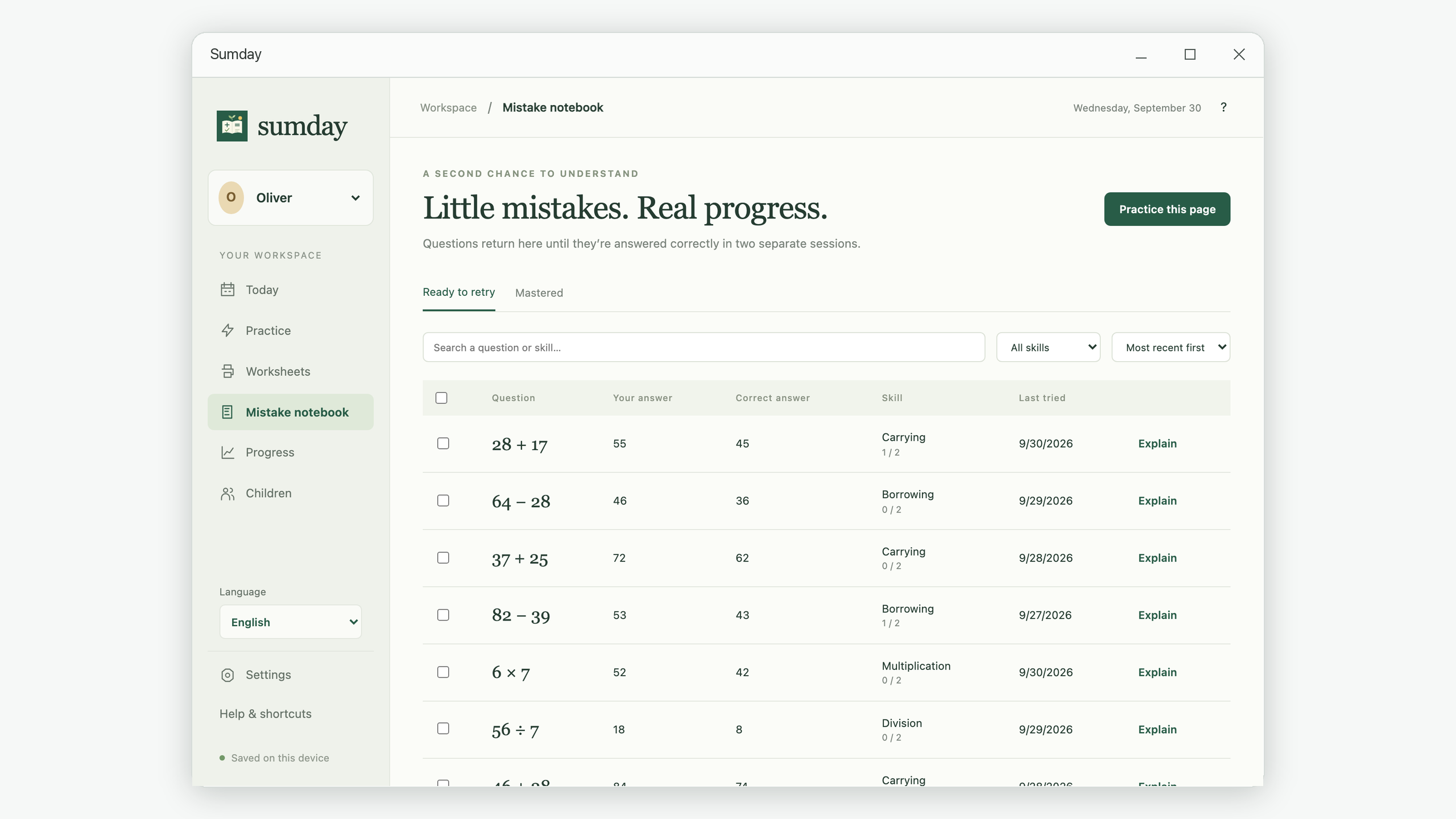
On-screen reviews include the selected original questions and fresh practice. In Sumday, two correct answers in separate sessions move a question to Mastered. A later missed answer reopens it. That label describes the app’s review rule; use your child’s explanation and independent work to judge understanding too.
4. Try this three-session review plan
| Session | What to do | What to notice |
|---|---|---|
| First | Model 64 − 28 with tens and ones, then solve two similar questions together. | Can the child explain why one ten became ten ones? |
| Next | Review a few notebook questions without giving the answer first. | Do the written exchange marks and tens calculation agree? |
| Later | Mix a few borrowing and no-borrowing questions. | Can the child decide when an exchange is needed? |
The schedule is a starting template, not a deadline. If your child needs help at the same step, return to the model and shorten the independent practice. If written layout is the main problem, try Column arithmetic or a worksheet with more writing room. Keep the goal specific: explain the exchange and use it correctly on a fresh question.